what types of organisms are the first to move back into a disturbed area
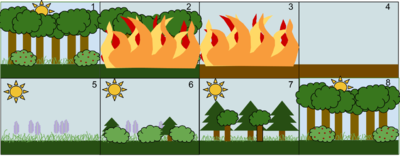
An example of Secondary Succession by stages:
1. A stable deciduous forest customs.
2. A disturbance, such as a fire, starts.
three. The burn down destroys the vegetation.
4. The fire leaves behind empty, but not destroyed soil.
5. Grasses and other herbaceous plants grow back beginning.
6. Small-scale bushes and copse begin to colonize the public area.
seven. Fast-growing evergreen copse and bamboo trees develop to their fullest, while shade-tolerant copse develop in the understory.
8. The short-lived and shade-intolerant evergreen trees die as the larger deciduous trees overtop them. The ecosystem is at present back to a similar state to where it began.
Secondary succession ecological succession of a plant'southward life. Every bit opposed to the first, primary succession, secondary succession is a process started by an event (e.m. forest fire, harvesting, hurricane, etc.) that reduces an already established ecosystem (eastward.g. a wood or a wheat field) to a smaller population of species, and every bit such secondary succession occurs on preexisting soil whereas primary succession usually occurs in a place defective soil. Many factors can impact secondary succession, such as trophic interaction, initial composition, and competition-colonization trade-offs.[1] The factors that command the increment in abundance of a species during succession may be determined mainly by seed production and dispersal, micro climate; mural structure (habitat patch size and distance to outside seed sources);[1] bulk density, pH, and soil texture (sand and dirt).[2]
Simply put, secondary succession is the ecological succession that occurs later the initial succession has been disrupted and some plants and animals still exist. It is usually faster than chief succession
- Soil is already present
- Seeds, roots, and undercover vegetative organs of plants may withal survive in the soil.
Examples [edit]
Imperata [edit]
Imperata grasslands are caused past human activities such equally logging, forest clearing for shifting tillage, agriculture and grazing, and likewise by frequent fires. The latter is a frequent effect of homo interference.[three] Nonetheless, when non maintained by frequent fires and human disturbances, they regenerate naturally and speedily to secondary young forest. The fourth dimension of succession in Imperata grassland (for example in Samboja Lestari area), Imperata cylindrica has the highest coverage but it becomes less dominant from the 4th year onwards. While Imperata decreases, the percent of shrubs and immature trees clearly increases with time. In the burned plots, Melastoma malabathricum, Eupatorium inulaefolium, Ficus sp., and Vitex pinnata. strongly increase with the age of regeneration, but these species are commonly establish in the secondary forest.[4]
Soil properties change during secondary succession in Imperata grassland area. The effects of secondary succession on soil are strongest in the A-horizon (0–x cm), where an increase in carbon stock, North, and C/Northward ratio, and a decrease in bulk density and pH are observed. Soil carbon stocks also increase upon secondary succession from Imperata grassland to secondary forest.[2]
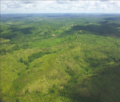
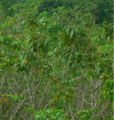
- Secondary succession in Imperata-dominated grassland
-
-

-
Oak and hickory forest [edit]
A classic instance of secondary succession occurs in oak and hickory forests cleared by wildfire. Wildfires will burn most vegetation and impale those animals unable to flee the area. Their nutrients, however, are returned to the ground in the grade of ash. Thus, even when areas are devoid of life due to severe fires, the area volition soon be ready for new life to accept hold. Before the fire, the vegetation was dominated past tall trees with access to the major establish energy resource: sunlight. Their meridian gave them access to sunlight while besides shading the ground and other depression-lying species. After the fire, though, these trees are no longer ascendant. Thus, the first plants to grow back are usually annual plants followed inside a few years past rapidly growing and spreading grasses and other pioneer species. Due to, at least in part, changes in the environment brought on by the growth of the grasses and other species, over many years, shrubs will emerge along with small pine, oak, and hickory copse. These organisms are called intermediate species. Eventually, over 150 years, the forest will achieve its equilibrium betoken where species composition is no longer changing and resembles the customs before the fire. This equilibrium state is referred to equally the climax community, which will remain stable until the next disturbance.[5]

Mail service-burn down succession [edit]
Soil [edit]
Generation of carbonates from burnt plant textile following fire disturbance causes an initial increase in soil pH that can affect the rate of secondary succession, as well as what types of organisms will exist able to thrive. Soil composition prior to fire disturbance also influences secondary succession, both in charge per unit and blazon of dominant species growth. For instance, high sand concentration was plant to increment the chances of primary Pteridium over Imperata growth in Imperata grassland.[six] The byproducts of combustion have been shown to bear upon secondary succession by soil microorganisms. For case, certain fungal species such as Trichoderma polysporum and Penicillium janthinellum have a significantly decreased success rate in spore germination within fire-affected areas, reducing their ability to recolonize.[7]
Vegetation [edit]
Vegetation structure is affected by burn. In some types of ecosystems this creates a process of renewal. Following a burn down, early on successional species disperse and establish first. This is followed by late-successional species. Species that are burn intolerant are those that are more combustible and are desolated by fire. More tolerant species are able to survive or disperse in the consequence of burn. The occurrence of burn down leads to the establishment of deadwood and snags in forests. This creates habitat and resources for a diverseness of species.
Fire can human action equally a seed-dispersing stimulant. Many species crave fire events to reproduce, disperse, and establish. For example, the knobcone pine has closed cones that open for dispersal when exposed to estrus acquired by forest fires. Information technology grows in clusters because of this express method of seed dispersal. A tough fire resistant outer bark and lack of low branches assist the knobcone pine survive burn down with minimal harm.[8]
References [edit]
- ^ a b Cook, W.Thou.; Yao, J.; Forster, B.L.; Holt, R.D.; Patricks, 50.B. (2005). "Secondary succession in an experimentally fragmented landscape: Community design beyond space and time" (PDF). Environmental. 86 (5): 1267–1279. doi:10.1890/04-0320. hdl:1808/16487.
- ^ a b Van der Kamp, J.; Yassir, I.; Buurman, P. (2009). "Soil carbon changes upon secondary succession in Imperata grasslands (East Kalimantan, Indonesia)". Geoderma. 149 (ane–ii): 76–83. doi:10.1016/j.geoderma.2008.11.033.
- ^ MacKinnon, One thousand., Hatta, G., Halim, H., Mangalik, A., 1996. Environmental of Kalimantan. The ecology of Indonesia Seri Vol. Three
- ^ Yassir, I.; Van der Kamp, J.; Buurman, P. (2010). "Secondary succession after burn down in Imperata grasslands of East Kalimantan, Indonesia". Agriculture, Ecosystems and Environment. 137 (ane–2): 172–182. doi:ten.1016/j.agee.2010.02.001.
- ^ "45.6 Community Ecology". OpenStax CNX . Retrieved 2017-07-30 .
- ^ Yassir, I. (xv April 2010). "Secondary succession after burn down in ImperataIndonesia". Agriculture, Ecosystems & Surround. 137 (1–2): 172–182. doi:ten.1016/j.agee.2010.02.001.
- ^ Widden, P. (March 1975). "The effects of a forest burn on soil microfungi". Soil Biological science and Biochemistry. 7 (ii): 125–138. doi:x.1016/0038-0717(75)90010-iii.
- ^ Burczyk, Jaroslaw; Adams, Westward. T.; Shimizu, Jarbas Y. (iii October 1996). "Mating patterns and pollen dispersal in a natural knobcone pine (Pinus attenuata Lemmon.) stand up". Heredity. 77 (3): 251–260. doi:ten.1038/sj.hdy.6880410.
Source: https://en.wikipedia.org/wiki/Secondary_succession
0 Response to "what types of organisms are the first to move back into a disturbed area"
Post a Comment