If We Send the Same Email Again Will It Get Spammed
Email is a powerful mode to accomplish your target audience and grow your customer base of operations. Nearly lx percentage of users say that marketing emails influence their purchases. However, every bit online privacy and protection laws tighten, getting your emails into recipients' inboxes has become tougher.
If your emails are catastrophe up in users' spam folders, don't worry. By following some elementary all-time practices, you can not only make certain your emails reach their recipients, but also encourage college open rates and brand a stronger touch on.
In this article, we'll explore why emails end up in spam and what y'all can practice about information technology.
That'due south a lot of ground to embrace, and so let'south dive in!
Adopt to sentry the video version?
Why Spam Is a Problem for Electronic mail Marketers
Estimates indicate that as many every bit 60 billion spam emails volition be sent every day between 2022 and 2023. Obviously, users don't appreciate that inundation of spam. However, this is also a major trouble for email marketers. Upward to twenty percent of emails will never make it to the recipient'southward inbox, preventing you from reaching your audition.
With email delivering an boilerplate Render on Investment (ROI) of 122 per centum, it's important to minimize the risk that your letters are in that 20 percent. Every e-mail that lands in spam is wasted money on your part, both for the email itself and any potential conversions it might have generated.
Fortunately, in that location's a lot you tin can do to proceed your letters out of spam folders, and nigh of it is adequately straightforward. In the adjacent section, nosotros'll look at some of the most common reasons email goes to spam, and come across how yous tin can avoid them.
Why Are My Emails Going to Spam? (nine Potential Reasons)
There are numerous reasons emails might exist identified as spam, ranging from keywords that trigger spam filters to incorrect permissions.
Let's walk through some of the most common scenarios, and explore what you can do to make sure your messages state in users' inboxes.
i. Your Recipients Marked Your Emails as Spam
The kickoff and most obvious reason for your emails catastrophe upwards in spam is considering your recipients put them there.
Even if your content is potent and the recipient expressly gave you permission to contact them, they may still decide to mark your e-mail every bit spam as a way to clean up a cluttered inbox.
They may also take forgotten why they subscribed to your listing in the first place, or simply made a fault.

Unfortunately, if enough of your letters get flagged by users, it tin can crusade spam filters to flag your address and offset sending your mail service to spam automatically.
This means your messages may end up looking similar spam, fifty-fifty to users who haven't explicitly flagged you in the past. This is especially likely in Gmail, Outlook, Yahoo, and other services with heavily AI-driven algorithms.
Once the email ships, there's not much you can exercise to preclude someone from marking your emails as spam.
What you can exercise is make certain your content is top-notch, and that you follow other best practices to avert having your email perceived as spam by users. This tin minimize the chance that someone will intentionally flag your communications. We'll cover some of these strategies in the post-obit sections.
2. You're Not Following HTML Best Practices
While text-only emails are fairly straightforward, they might not be a viable pick for some businesses like ecommerce stores equally they may lead to lower engagement when compared to emails that include branding, images, and other HTML elements.
However, when including HTML in your letters, information technology's important to follow some simple rules to ensure that they don't stop up in spam folders.
Here are some HTML best practices for e-mail, according to Mailchimp:
- Keep the maximum width of your email between 600 and 800 pixels. This ensures that it'south large enough to read easily, while also behaving well in e-mail client preview panes.
- Assume that any images will be blocked past email clients and that users may not see critical data if it's independent within media elements.
- Keep your lawmaking as make clean and light as possible, particularly CSS. In addition, avert JavaScript and Flash entirely. These may exist seen as vectors for assault past spam filters, and many electronic mail clients don't support them anyway.
- Make certain your messages are mobile-friendly. In fact, information technology's generally a good thought to blueprint everything with a mobile-get-go philosophy these days. That ways thumb-friendly buttons, small images that won't overload mobile networks, and email-safety fonts that are readable on modest screens.
- When it comes to fonts, you'll also want to make sure the ones you lot choose are cross-platform and clearly legible. Arial, Verdana, and Georgia are all solid options.
Finally, information technology's a good idea to make most of your email'due south content text, and minimize the amount of HTML you lot include. Your company branding and maybe a pop of color can do wonders for engagement, without going overboard.
3. Your Discipline Lines Are Misleading or Contain Spam Triggers
Subject lines are typically the first impression a user gets of your message, so they demand to grab attention and entice the reader to open the e-mail. However, they also need to be honest. A misleading subject line isn't simply poor etiquette, it'southward also against the law, according to the CAN-SPAM Act.
Over half of email respondents report feeling cheated or tricked into opening an email based on the subject line, according to Litmus. That'south a quick way to become your email tossed in the spam binder, and it may even pb some users to unsubscribe.
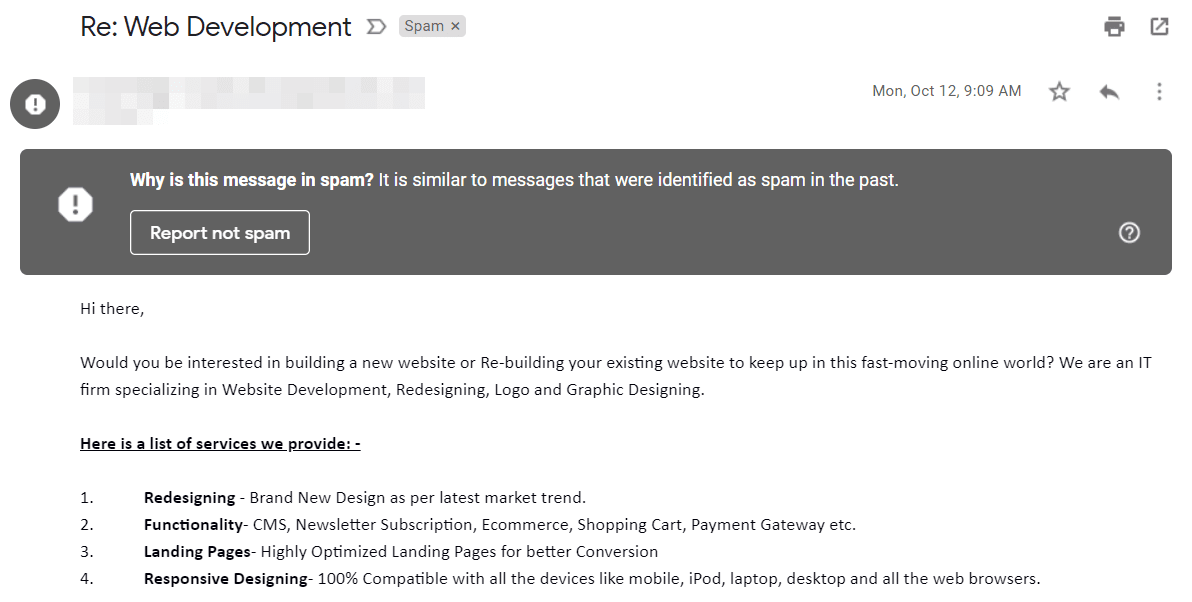
What does a misleading subject line look like? Here are some examples:
Subscribe Now
- RE or FW. Don't offset your subject field lines with "RE" unless you're actually replying to something. It's a breathy flim-flam and a quick mode to earn an unsubscribe. Similarly, using "FW" can make the person think they know y'all (the definition of misleading).
- Personal messages or leading questions. Subjects like "Did I leave my phone at your identify?" or "Did you hear near so-and-so?" may make users question whether they know the sender.
- Overly sensational claims. Some subject lines aren't necessarily lies but are still a little too over-the-top. In full general, you desire to make sure that your discipline line matches the content the reader volition find in the electronic mail.
Your field of study lines should also be professional person. That means no TYPING IN ALL CAPS and definitely no spelling or grammar errors. The gratis tool Grammarly tin check your spelling, grammar, and punctuation automatically, and alert yous of whatever issues that may alert spam filters.
Now yous know what subject area lines to avert, but you nonetheless need to entice subscribers to open your letters. Hubspot has some fantabulous recommendations for creating strong headlines:
- Start with action verbs.
- Create a sense of urgency and importance (but over again, don't exist misleading).
- Pose an interesting or compelling question.
Finally, remember: any your subject field line ends upwardly existence, make certain the content delivers on its promise. Otherwise, yous risk damaging your reputation.
4. You Don't Have Permission From Your Recipients
This one is simple: online privacy laws like the GDPR require that yous must have limited permission from recipients in order to send them emails. That means you can't simply purchase email lists to get quick access to a agglomeration of contacts (this isn't a expert idea for other reasons, as well, including poor targeting).
However, it too means that fifty-fifty users who provide their email addresses on your site demand to explicitly tell you that they want to receive emails from you, peculiarly if they're a denizen of the Eu. This can come in the form of a disclaimer during account creation or on your contact form, or it could be a checkbox that users need to tick to indicate their willingness.
While this isn't necessarily required in the U.S., it's still a good practice. People become a lot of emails these days,and if your letters start suddenly appearing in someone's inbox when they didn't ask for them, in that location's a decent chance they may be marked as spam.
5. Your Content Triggers Spam Filters
Spam filters check for certain words (or combinations of words). If an e-mail gets enough hits or contains those words in addition to some of the other items on this list, it tin can end up in spam folders. Spam trigger keywords tin include:
- "Gratis"
- "Everyman price"
- "Additional income"
- "Like shooting fish in a barrel money"
- "No price"
- Multiple exclamation points or dollar signs in a row
- Words with unnecessary spaces or punctuation
- Words that are in ALL CAPS
In full general, these are words that are either heavily sales-oriented or clearly designed to go around spam filters (such as the extra spaces). While using a handful of these isn't necessarily a death judgement for your messages, using also many of them can be.

Of course, some of these keywords are tough to avoid, especially if you're sending ecommerce or financial emails. To go around this trouble, you tin use varied language and try to get creative well-nigh how you phrase things.
Above all, it's smart to avoid pushy or "salesy" language and make sure you're following proven best practices for writing email content we're highlighting here.
vi. You Don't Include an Unsubscribe Link
Laws similar Can-SPAM in the U.S. conspicuously country that your emails must include a clear way to unsubscribe. Additionally, if someone does click on the unsubscribe link, you'll need to procedure that request within ten days, and you can't strength the user to jump through any hoops.
While this might seem like a bad affair (why would you want to give people the risk to unsubscribe?), it can actually take the contrary upshot, provided that your content is strong. Giving people an like shooting fish in a barrel style to get off your subscriber list shows that your make is trustworthy.
On the other hand, hiding or simply not providing an unsubscribe selection is a sure-fire way to frustrate people. It can also result in negative press virtually your newsletter (give-and-take travels fast on the net), and more often than not rub people the incorrect fashion.
7. Your 'From' Information Is Wrong or Misleading
A major reason that your emails may stop up in spam is incorrect 'From' information. The 'From' line, the one that tells your recipients who sent the email, needs to be accurate and not misleading. In some cases, a tool on your site such every bit a contact class plugin might be sending 'spoof' emails with 'From' details that trigger spam alerts.
If your contact form emails are getting flagged as spam, the fix is usually pretty uncomplicated. You'll want to brand sure that the 'From' field in your contact course settings has the admin address for your site, rather than the email address entered into the form. If you're having the contact form ship you lot email notifications, also make sure the addresses used in 'From' and 'To' are unlike.
8. You Haven't Prepare Email Authentication
Some other common reason that your emails' 'From' data may be wrong is when e-mail authentication isn't properly ready through a service like Mailchimp (or one of its alternatives):
Hallmark authorizes the service to send emails on your behalf, then they'll appear with your domain name attached fifty-fifty though they were sent by a third political party. If your authentication isn't set up properly, your emails tin end upwardly going directly to your recipients' spam boxes.
In that location are a few dissimilar types of email authentication out at that place, with the main ones beingness DomainKey Identified Postal service (DKIM), Sender Policy Framework (SPF), and DMARC.
DKIM provides an encryption key and digital signature to verify an email, while SPF works by verifying the IP address of the sender against a listing of canonical IPs. DMARC is a bit different, in that it requires the other 2 to exist enabled and lets the sender indicate that their emails are protected by DKIM or SPF.
If you apply an automatic electronic mail service and y'all're having problems with delivery, hallmark is a good outset thing to cheque. If y'all demand help with this, we have a handy article detailing exactly how to fix email hallmark.
9. You're Sending Too Many Attachments
Attachments are a huge red flag for most spam filters. This is because files can be easy vectors for malware and viruses. The general rule of thumb is to only non send any attachments at all, particularly in newsletters. If you lot do need to send an attachment, make sure the recipient is aware alee of time, and minimize the number of files you attach to a single email.
If you have to adhere a document or file to an electronic mail, a safer bet is to starting time upload it to a cloud storage service like Google Drive or Dropbox. Y'all can then include the link to the file in your email. That way, your message shouldn't trigger any spam filters.
Summary
There are many reasons why your emails might end up in spam folders, from poor bailiwick lines to keywords that trigger spam filters. Whatever the reason, information technology'south important to resolve the issue to maximize your return on investment and maintain a trustworthy reputation amid your audience.
By addressing these bug speedily and implementing some proven best practices, yous tin can easily keep your letters out of spam. All-time of all, those same practices tin also increase your messages' impact, and hopefully convert more subscribers into customers.
Practice you have whatsoever questions about the email marketing best practices outlined higher up? Let us know in the comments section below!
Relieve fourth dimension, costs and maximize site performance with:
- Instant assist from WordPress hosting experts, 24/7.
- Cloudflare Enterprise integration.
- Global audience reach with 32 information centers worldwide.
- Optimization with our congenital-in Application Functioning Monitoring.
All of that and much more, in one program with no long-term contracts, assisted migrations, and a 30-24-hour interval-coin-back-guarantee. Check out our plans or talk to sales to discover the program that's right for yous.
Source: https://kinsta.com/blog/why-are-my-emails-going-to-spam/
0 Response to "If We Send the Same Email Again Will It Get Spammed"
Post a Comment